How did your journey in music begin?
I think it really started when my mother noticed I was always tapping along to whatever music was playing. In fourth grade I officially joined the percussion section in the Middleborough schools. I was inspired early on by Gene Krupa, Buddy Rich, and the great swing drummers. Their energy hooked me.
Were there early experiences that shaped your path?
Absolutely. As a teenager I played in a band called Destiny’s Children—we did every school dance we could. But the defining moment came on a school trip to a Boston Symphony Youth Concert. I was completely captivated by the percussion section and knew right then that I wanted to study seriously, including with Vic Firth someday. I later had the privilege of studying with him during my master’s program.
You were part of the BSO Youth Orchestra—what was that like?
Life-changing. My band director urged me to audition, and when I made it in, it opened everything up. As a high-school freshman, I took the bus into Boston every Saturday morning for rehearsals. I even got to tour Great Britain with them. It cemented my love of orchestral playing.
How did teaching become part of your life?
My father—who was also a teacher—encouraged me to get a teaching certificate while majoring in performance. That turned out to be wise advice. Not long after graduation, Lakeville’s music director called needing a percussion teacher for a few days a week. I ended up teaching middle school band, jazz percussion, and woodwinds for 34 years.
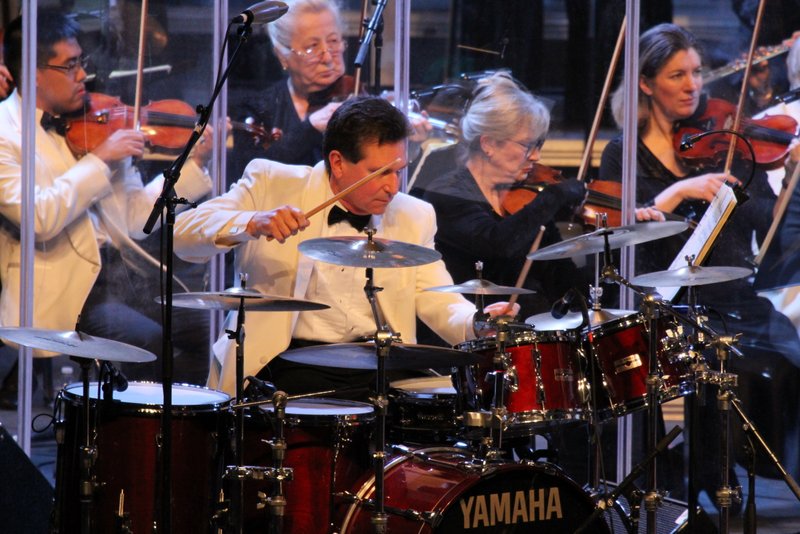
You also performed constantly outside the classroom.
In the 1970s, yes! I played in a wedding band back when there were no DJs. I was busy every weekend—that’s how I made my living for a long time. Music has always been my life.
And you’re a collector of vintage snare drums?
I am. For my 25th season, I had a custom Revolutionary War–style rope drum built, hand-painted with the Mayflower. It’s a special piece.
How did you first connect with the Phil?
It’s a fun story. In 1992 I decided to retire from the wedding band and packed up all my gear. A colleague gave me tickets to a Plymouth Phil concert. I was absolutely blown away—the orchestra had grown tremendously under Steven. I went home, pulled out my drum pad, and started practicing again. That concert reignited something in me.
A little later I got a call asking if I could play drum set for the July 4th concert in 1999. I was very nervous—but Steven and I clicked immediately. Soon after, I played principal on the opening concert of the season. And very interestingly that concert turned out to be my audition for a full time position in the Orchestra.
What continues to challenge you as a percussionist?
Honestly, every piece is a challenge. The percussion section is full of soloists, and we juggle so many instruments that one lapse in concentration can throw things off. I’ve lost sleep over missed entrances. Sometimes you’re waiting for that exact right moment… your heart pounding… and then it finally comes. And yes—the infamous “sizzle crash” is its own special challenge.
How do you prepare for different musical styles?
I immerse myself completely. If we’re playing Motown or film music—like Hooray for Hollywood—I’ll make playlists and listen at the gym. My workout routine includes free weights, cardio, yoga, and Pilates. I’m usually the only guy in the class, and I’m always impressed with the strength of my classmates. Yoga keeps me strong and centered; it’s essential.
What do you love most about playing with the Phil?
Steven and the musicians. Everyone is prepared. The programming is fantastic. And I’m always discovering new music. It’s a joy to be part of it.
Do you have any advice for young musicians?
Do the best job you can. Play music because you love it—not because you expect to become a millionaire. There’s a lot of unseen work behind the beauty of a performance. It’s like an iceberg: the part above the water is what the audience sees, but the huge portion below is all the effort that makes it possible. And it’s worth every bit of it.